How we work: method, priorities and funding
One idea runs through thirty years of DRRA’s work: develop a practical model with the community, test it, document it, and transfer it to the institutions that will sustain it.
Six parts, one method
We develop, test, document and transfer practical models that strengthen communities, influence systems and build local institutions. Since 2005 the work has followed a twin-track approach: specialised support for the individual, and changes to mainstream services so that the individual can use them.
A · A low-cost community model
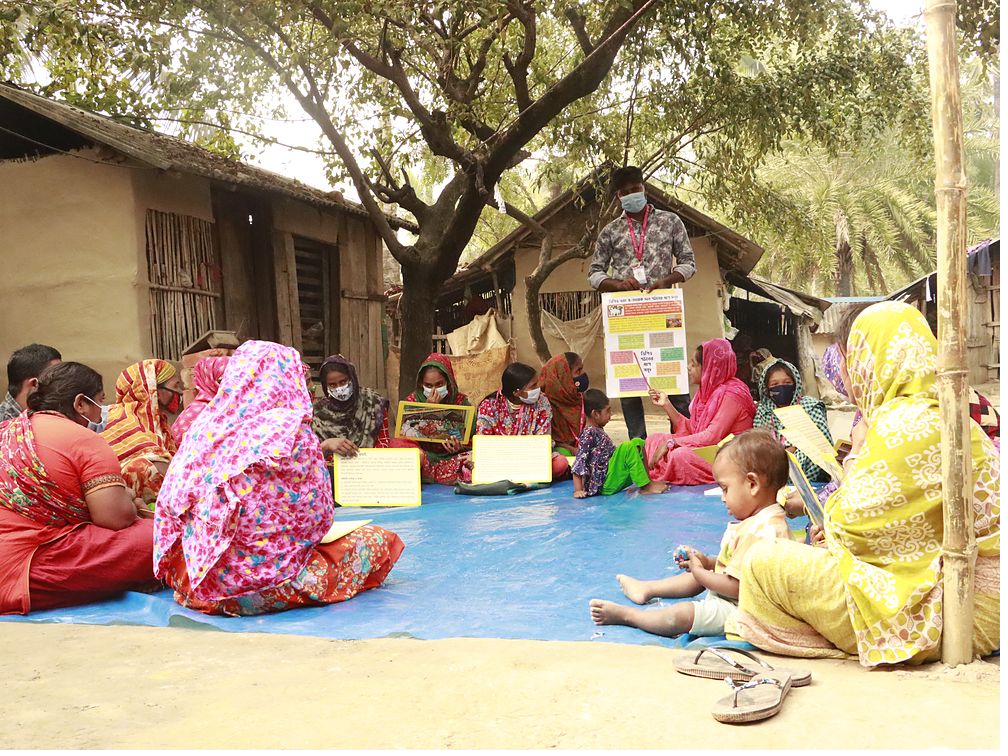
Community-based rehabilitation that grew into inclusive community development. Village rehabilitation centres were set up by community members to remove travel costs, and trained “champion mothers” give therapy and teach other mothers. In 2018 DRRA reframed the work as community-based inclusive development.
B · Collaboration with government
Models are tested inside public institutions so that government can adopt what works: rehabilitation centres in government hospitals, a national guideline on defining disability, and work with Union Parishads on disaster plans. Government decides what to adopt.
C · Strengthening local institutions
DRRA works through local government, organisations of persons with disabilities, self-help groups, community-based organisations, partner NGOs and small entrepreneurs. Each takes on more responsibility as its capacity grows: graduation, shared responsibility, handover and exit.
D · Inclusive microfinance
Persons with disabilities are often refused credit. Our model combined skills training with interest-free, collateral-free loans from local microfinance institutions and government services. Start-up resources in DRRA’s livelihood work are given as revolving funds.
E · Digitalisation and research
An online register was built for the mobile rehabilitation service in 2011. DRRA’s Research, Evaluation and Data department produces baselines, outcome studies and policy analyses.
F · An adaptive model and learning cycle
Every model is treated as a hypothesis. In the era of the Sustainable Development Goals DRRA began to use a deliberate learning cycle, set out below. Each turn of the cycle moves decisions closer to the communities and local institutions who live with the results.
The adaptive learning cycle
Nine steps, repeated. Each turn starts from what the last one taught us.
1. Observe
Field staff, mothers’ groups and organisations of persons with disabilities notice who is missing from school, health care or community life.
2. Research
The research department measures the gap with surveys, assessments and policy reviews.
3. Identify gaps
The research locates the barrier that matters most.
4. Co-design solutions
Responses are designed with persons with disabilities, families, partners and the officials who will run them.
5. Pilot and test
Models are tested inside the institutions that would own them.
6. Review evidence
Outcome reviews, change stories and follow-up studies test the results, including disappointing ones.
7. Adapt the model
Findings change the model, sometimes in detail and sometimes as a whole.
8. Strengthen local ownership
Mothers, OPDs, partner NGOs and local government take on running the model.
9. Replicate where appropriate
Models that hold up are adapted by others to their own context.
Four priority sectors
DRRA’s priorities for the next decade, each building on work already delivered.
Climate Resilience & Just Transition
Disaster risk reduction and climate adaptation for districts most exposed to floods and cyclones. DRRA ran the Community-Centered Disability-Inclusive Disaster Risk Management project (CCDiDRM) in Shyamnagar, Satkhira.
AI & Tech-Enabled Social Impact
Digital tools and data for identification, referral and follow-up that can connect with government systems. DRRA built the SMILE online register in 2011 and describes Re-Health as its digital service platform. The government health service has committed to include disability data in national health information.
Localisation & Inclusion
More funding and decision-making for local organisations. DRRA has strengthened organisations of persons with disabilities (OPDs) in Satkhira in advocacy, fundraising and coordination.
Youth Employability & Green Skills
Skills training linked to jobs and recognised qualifications. DRRA became a partner training institute under PKSF’s SEIP programme in 2022, and has trained 200 young persons with disabilities under SICIP and 80 under SEIP.
Five funding models
Grants still matter. These models reduce dependence on any single funder.
CSR Co-Creation & Shared Value Partnerships
Co-design a project that solves a real problem while serving a corporate partner's own goals. Example: training marginalised youth to staff their supply chain.
It's a business case, not a charity ask. Easier for a company to fund at scale and renew each year.
Tech-Driven Micro-Donations & Digital Philanthropy
Local payment services plus clear online reporting. A donor can fund one specific outcome, such as an assistive device, from their phone.
Donors in Bangladesh and in the diaspora can see quickly and clearly what their gift has done.
Beneficiary Social Enterprises
Product lines made by the people in our programmes, with net profit cycled straight back into operations. See the shop →
Cuts donor dependency and proves economic inclusion in the same transaction.
Impact Bonds & Results-Based Financing
Investors fund the work upfront. If agreed, independently verified outcomes are met, for example a target employment rate for trainees with disabilities, a government or foundation repays them.
Shifts risk off traditional donors and pulls in private capital that wouldn't otherwise write a grant.
Peer-to-Peer Micro-Ambassador Campaigns
Community champions and volunteers get a personal fundraising link to run their own birthday drives or challenges on our behalf.
Low cost, and carried by the trust people already have in each other.
A five-year funding-mix target
Layering the models above on top of traditional grants, so one funder's decision can't stall the work.
Financial sustainability, built with families and youth
Financial sustainability is a long-term approach to reducing dependence on any single funding source, built around the families and young people DRRA works with.
Family Development Approach
Building household-level income alongside individual support, so families are not solely dependent on aid.
Youth Approach
Vocational training and job linkage designed around youth as future earners and leaders, not only beneficiaries.
Housing
Safe, accessible housing as a foundation for stability — not a one-time handout.
Entrepreneurship & Business Model
Small enterprise support, including DRRA's own social enterprise shop, feeding income back into the work.
Future sustainability initiatives
Early-stage areas DRRA is exploring. They are not yet established programmes.
Recycling
Turning garment-industry off-cuts into products, building on early work by trainees at Neela Centre.
Waste Management
Climate-resilient waste practices for the communities CCDiDRM already works in.
Technology
Digital identification, referral and follow-up that connect with government systems.
New Business Models
Growing the social enterprise shop into a larger, self-sustaining revenue line.
Fund a sector, not just a programme.
Multi-year giving for foundations and companies, aligned with DRRA’s priorities.